You know the feeling. A client email sits unanswered for two days, not because no one saw it, but because no one was sure whose job it was to reply. A proposal goes out late, not because the work was difficult, but because it passed through four people before anyone actually touched it. And when you ask, “What happened?”, the honest answer is usually, “I’m not sure.”
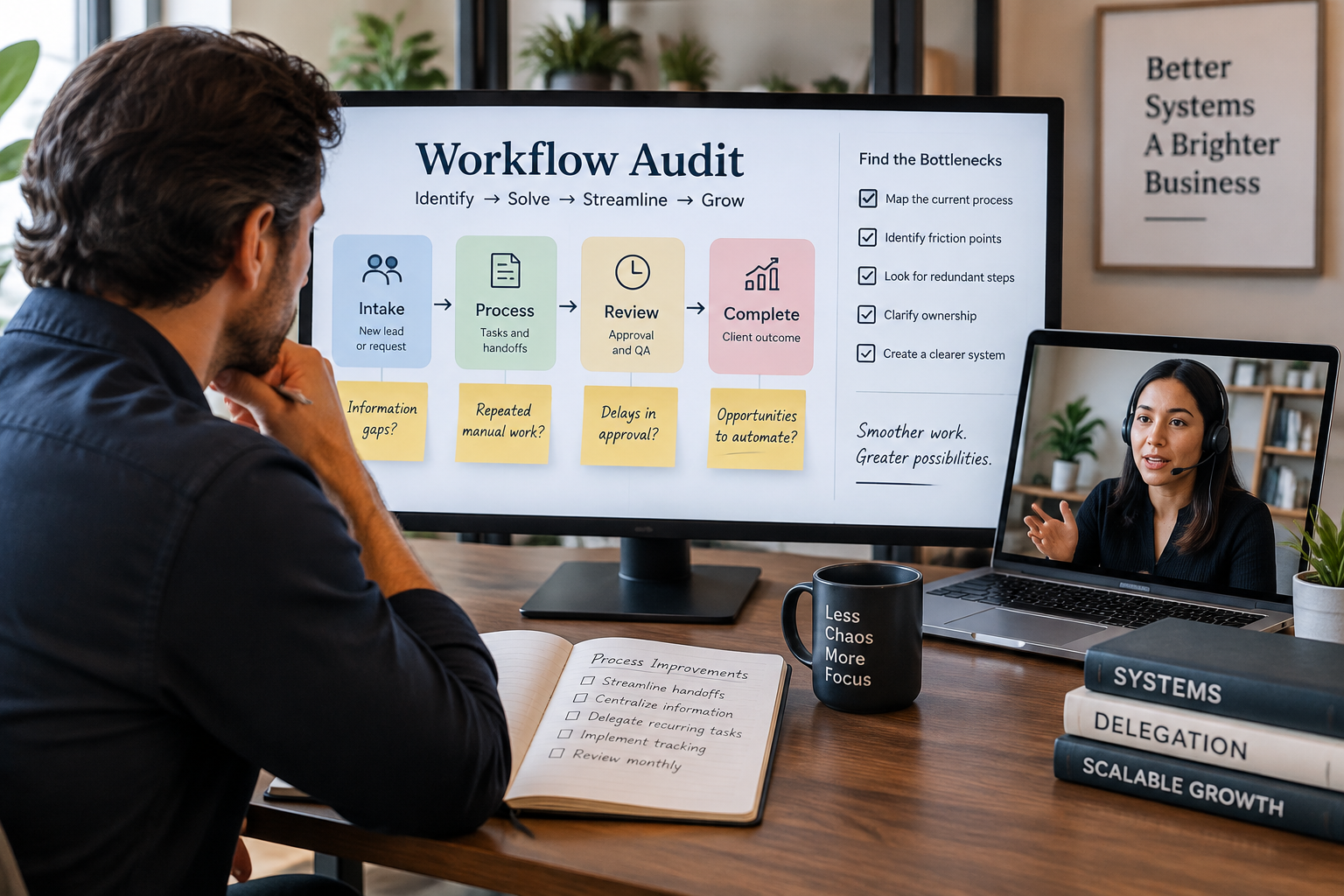
These are classic workflow bottlenecks, hidden slowdowns caused by unclear ownership, too many handoffs, and processes no one has ever mapped out. The good news is that you don’t have to guess where things are getting stuck. In this post, we’ll walk through a simple way to trace the delay, find the real bottleneck in your team’s process, and fix it at the source so your projects keep moving and your clients stay happy.
Why Workflows Stall in the First Place
Most business owners assume stalled work is a people problem: someone dropped the ball, someone needs to move faster, someone needs a reminder. In practice, the more common cause is that the workflow was never actually designed. It grew.
A task gets added to someone’s plate during a busy week. A new tool gets adopted without anyone updating the process around it. A step that used to matter stops mattering, but nobody removes it. Over time, the business is running on a patchwork of habits rather than a system, and patchwork breaks down exactly where the patches meet.
This matters because task switching itself carries a measurable cost. Research from the American Psychological Association has found that shifting between tasks, especially unfamiliar or complex ones, creates a “switching cost” in time and accuracy, and that this cost can consume up to 40% of a person’s productive time. When a workflow forces the same person to jump between client calls, invoicing, follow-up emails, and scheduling in no particular order, the slowdown isn’t laziness. It’s the structure of the work itself.
The Hidden Cost of Leaving It Alone
A stalled step rarely looks urgent at the moment. That’s exactly why it persists. But the cost compounds in ways that are easy to miss until they show up on a P&L or in a client’s tone.
Recent survey data from Upwork found that small business leaders spend close to a third of their working time (an average of 30%) on tasks outside their core role, translating to roughly 77 workdays a year of time that could be delegated or systematized. That same survey found the toll isn’t just time: the majority of leaders report burnout, and a substantial share report missed growth opportunities directly tied to being stretched too thin.
For a business owner, that 30% is rarely spent on one dramatic failure. It’s spent on dozens of small stalls: re-explaining a request that got lost, redoing a task because the first version used outdated information, chasing down an approval that sat in someone’s inbox. None of it feels like a crisis. All of it adds up to the same result, which is less time for the work that actually grows the business.
How It Shows Up in Growth, Revenue, and Trust
A missed follow-up may not immediately appear as lost revenue. A forgotten request may not immediately damage a relationship. But over time, small gaps in communication can affect customer experience and business reliability.
Revenue: Proposals and invoices that stall in review or approval push out your cash cycle and can cost you deals that go to a faster competitor.
Team: When responsibility for a task is unclear, capable people either duplicate effort or quietly avoid it, and both erode trust between team members.
Customer trust: Clients rarely complain about slow internal processes. They just notice that responses are inconsistent, and they draw their own conclusions about how the business is run.
Consider a composite example: a real estate team owner routinely lost three to four days between a signed listing agreement and the property actually going live on the MLS and marketing channels. On paper, the checklist was simple. In practice, the agent handed off photos to one person, the listing description to another, and the MLS entry to a third, with no single person tracking whether all three had actually happened. Every listing moved at the speed of whichever handoff got forgotten longest. The owner didn’t have a photography problem or a copywriting problem. She had a handoff problem that nobody had ever mapped out.
How the Right Support Makes a Difference
A workflow audit produces a map. What you do with that map determines whether anything actually changes.
This is where the distinction between task help and operational support matters. Handing off individual tasks without fixing the handoffs around them just moves the stall point somewhere else. The more durable fix is building a system, someone who owns the process end to end, tracks where work sits, and flags it before a client notices the delay, rather than someone who simply completes whatever lands in their inbox that day.
For the real estate team owner in the example above, the fix wasn’t hiring a fourth person to add to the handoff chain. It was consolidating listing intake under one coordinator role with a simple tracker showing where each listing stood, so no property could quietly stall between steps. The photos, the description, and the MLS entry still needed to happen. What changed was that someone was accountable for the sequence, not just the individual pieces.
The Small Change With Big Results
A workflow audit reframes the problem. Instead of asking “who dropped the ball,” you start asking “where does this process create ambiguity about ownership.” That shift alone changes how you hire, delegate, and build systems going forward.
If you’ve never mapped one of your core processes end to end, that’s worth doing before you add more to anyone’s plate, including your own. And if what the audit reveals is less a task problem than a missing owner for the process itself, that’s exactly the kind of gap a skilled operational partner is built to close.making decisions, building relationships, and moving the business forward. A reliable support system helps protect that time while ensuring important details continue moving.



Leave a Reply